What is the Model Context Protocol (MCP)?
MCP (Model Context Protocol) standardizes how an AI model reaches outside itself — to a database, an API, a filesystem, whatever. Before it, every integration was bespoke: a custom tool definition and glue code per app, per model, per data source. MCP replaces that with one protocol both sides implement once. The usual analogy is USB-C: everyone agreeing on the same connector is what makes it useful.
Host, client, server
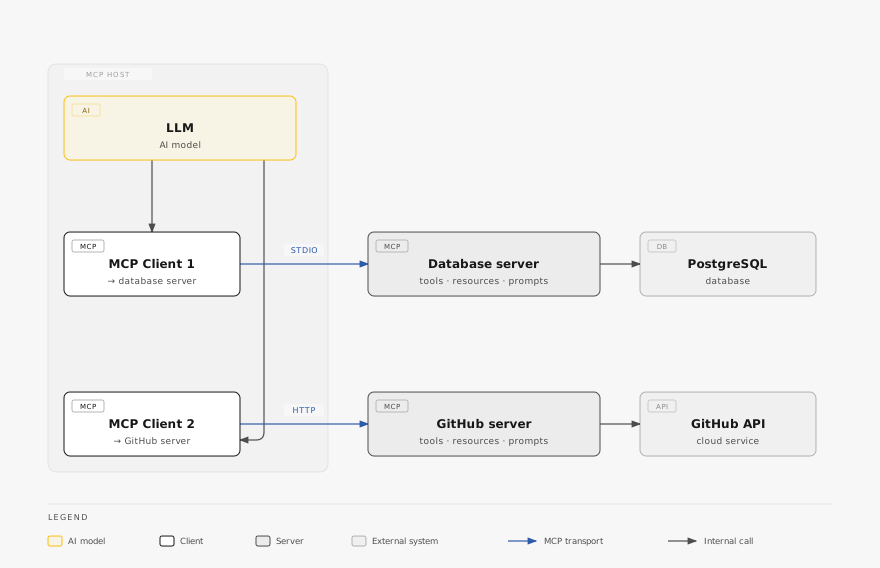
MCP defines three roles:
- Host — the AI application itself: Claude, an IDE, an agent. It embeds the model and decides when to reach outside it.
- Client — lives inside the host, one per server. It speaks MCP on one side and hands results back to the model on the other.
- Server — a small process that exposes capabilities over MCP: tools to call, resources to read, prompts to reuse.
Each client maintains a single, dedicated connection to exactly one server. Want to talk to both a database and GitHub, that’s two clients running side by side inside the same host — not one client juggling two connections.
Two transports
MCP doesn’t care whether the server is a process on your machine or an API across the network — the same request/response shape works either way. What changes is the transport underneath:
-
stdio — for a server running locally. The host spawns it as a subprocess and talks over its stdin/stdout. No network involved, so it’s the default for anything reading local files or hitting a local database.
-
Streamable HTTP — for a remote server. The client POSTs JSON-RPC requests to a single MCP endpoint; the server can respond directly or upgrade that same connection to a Server-Sent Events stream when it needs to push multiple messages back. This is what a hosted, shared MCP server (GitHub’s, for example) uses today.
It wasn’t always one endpoint. The original transport — HTTP+SSE — split the two directions across separate endpoints: the client POSTed to one URL, and a server-initiated GET on a second URL opened the SSE stream for everything coming back. The spec deprecated that split in favor of Streamable HTTP’s single endpoint back in March 2025, though some older servers still speak it for backwards compatibility.
What a server actually exposes
Every server advertises the same three primitive types, regardless of transport:
- Tools — functions the model can invoke (
create_issue,run_query). - Resources — data it can read (a file, a row, a config value).
- Prompts — reusable prompt templates the server hands the host, rather than the host hand-rolling them per integration.
That fixed vocabulary is what makes MCP a protocol rather than just a convention: a client doesn’t need to know anything about a server ahead of time beyond “speak MCP” — it discovers what’s actually on offer at connection time.